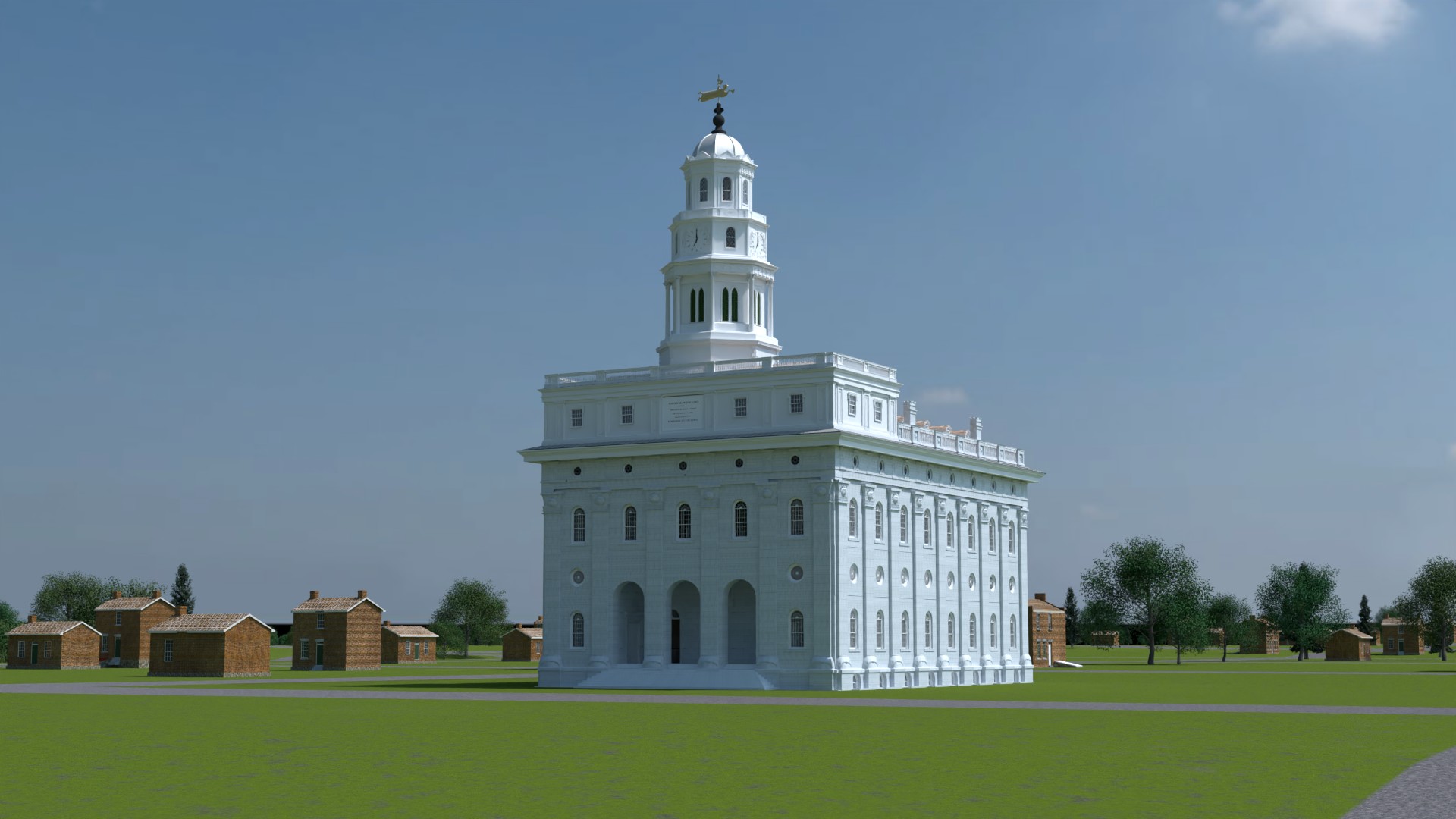
Nauvoo Temple 1846 Wiki
Quick Facts
ANNOUNCED
31 August 1840
ANNOUNCED BY
Joseph Smith Jr.
GROUNDBREAKING
18 February 1841
GROUNDBREAKING PRESIDED BY
Joseph Smith Jr.
DEDICATED
30 April 1846
DEDICATED BY
Joseph Young
The Nauvoo Temple was the second temple constructed by the Church.[1]Manuscript History of the Church, LDS Church Archives, book A-1, p. 37; reproduced in Dean C. Jessee (comp.) (1989). The Papers of Joseph Smith: Autobiographical and Historical Writings (Salt Lake City, Utah: Deseret Book) 1:302–03. The church’s first temple was completed in Kirtland, Ohio, in 1836.
When the main body of the church was forced out of Nauvoo, Illinois, in the winter of 1846, the church attempted to sell the building, finally succeeding in 1848. The building was damaged by fire and a tornado before being demolished.
In 1937, The Church reacquired the lot on which the original temple had stood. In 2000, the church began to build a temple on the original site whose exterior is a replica of the first temple, but whose interior is laid out like a modern Latter-day Saint temple. On 27 June 2002, a date that coincided with the 158th anniversary of the death of Joseph and Hyrum Smith, the temple was dedicated by the LDS Church as the Nauvoo Illinois Temple.
Description
History
Announcement
“I have seen in vision the splendid appearance of that building illuminated, and will have it built according to the pattern shown me.” —Joseph Smith, Jr.
The Latter-Day Saints made preparations to build a temple soon after establishing their headquarters at Nauvoo, Illinois, in 1839.
31 August 1840
The Prophet Joseph Smith Issued a proclamation “to the saints scattered abroad,” in which he counseled the Saints to give attention to gathering to and building a temple in Nauvoo.[2]Documentary History of the Church, IV, p. 186-187
October 1840
During general conference, the Saints unanimously accepted a proposal to build the temple. Leaders formed a temple committee. Later that fall, leaders chose a site for the temple on the bluff overlooking the Mississippi River.
Groundbreaking Announced
19 January 1841
The Lord officially instructed the Saints to “build a house to my name, even in this place [Nauvoo]” (D&C 124:55).[3]”Section 124,” Doctrine and Covenants, p.246, https://www.churchofjesuschrist.org/study/scriptures/dc-testament/dc/124
Groundbreaking
February 1841
Leaders selected a young New England convert by the name of William Weeks to be the chief architect, and construction began.
GROUNDBREAKING ORDER
-2-
While the temple was the second temple announced by the Church, it will not be included in the chronology included on this site, as it was abandoned and destroyed before being rebuilt.
| Date | 1841 02 18 |
| By | # |
| Role | # |
| Attendees | # |
⮜Preceded by Kirtland
Followed by St. George Utah⮞
Cornerstone Ceremony
6 April 1841
The temple’s cornerstone was laid under the direction of Joseph Smith and Sidney Rigdon gave the principal oration.
2 October 1841
The Lord had revealed that baptisms for the dead in the Mississippi River were acceptable only in the days of their poverty when no baptismal font was available for that purpose, but as soon as the font was available in the Temple, baptisms in the river should be discontinued. At the conference of the Church held in Nauvoo, on October 2, 1841, the Prophet made this announcement: “There shall be no more baptisms for the dead, until the ordinance can be attended to in the Lord’s House, and the Church will not hold another General Conference until they can meet on said house, for thus saith the Lord.”
Baptistry Dedication
8 November 1841
Pushed to completion during the first year of construction, the temporary wooden baptismal font was the first portion of the building to be used. The wooden font was to be temporary, and a more durable one would replace it at a later date. Brigham Young, president of the Quorum of the Twelve, dedicated the baptismal font in appropriate ceremonies at 5 p.m. on 8 November 1841.[4]Roberts, History of the Church, 7:580.
So anxious were they to commence the work, a temporary frame building, with oak clapboards for siding and roofing, were constructed around the font as temporary shelter, low enough that the first floor framing could be constructed above it.
BAPTISTRY DEDICATION
| Date | 1841 11 08 |
| By | Brigham Young |
| Role | Apostle |
| Sessions | # |
| Attendees | # |
Dedicatory Prayer
21 November 1841
On Sunday, November 21, 1841, “The council met in council at Brigham Young’s house, and at four o’clock they repaired to the baptismal font in the Temple, where President Brigham Young, Elders Heber C. Kimball and John Taylor baptized about forty persons for their dead, Elders Willard Richards, Wilford Woodruff and George A. Smith confirmed them. These were the first baptisms for the dead in the font in the Lord’s House. From this time forth, as long as the Saints remained in Nauvoo, baptisms for the dead were performed in the Temple.”[5](Essentials in Church History by Joseph Fielding Smith, pp. 310-1.)
Martyrdom
27 June 1844
The martyrdom of the Prophet Joseph Smith forced a suspension of all labors. By 7 July, work resumed and, in fact, intensified.
Construction was only half complete at the Death of Joseph Smith in 1844. After a succession crisis, Brigham Young was sustained as the church’s leader by the majority of Latter-Day Saints in Nauvoo. As mob violence increased during the summer of 1845, he encouraged the Latter-Day Saints to complete the temple even as they prepared to abandon the city, so portions of it could be used for Latter-Day Saint ordinance, such as baptisms for the dead in the basement font. During the winter of 1845-46, the temple began to be used for additional ordinances, including the Nauvoo-era endowment, sealings in marriage, and adoptions. The Nauvoo Temple was in use for less than three months.
Upper Portions Dedication
30 November 1845
The attic and other portions of the upper level of the temple were dedicated.
UPPER DEDICATION
| Date | 1845 11 30 |
| By | |
| Role | |
| Sessions | # |
| Attendees | # |
Dedicatory Prayer
10 December 1845
The first endowments were administered, and soon the temple was operating virtually around the clock.
4 February 1846
The first wave of wagons began to roll westward from the city.
9 February 1846
At about 3:30 P.M., fire erupted on the roof of the temple. The blaze was extinguished quickly and caused only minor damage. It was suspected that enemies of the Church had started the fire, but the Saints soon learned that a stovepipe had ignited clothes drying in an attic room.
30 April 1846
Joseph Young dedicated the temple in a private ceremony. The next day Orson Hyde offered the first of several public dedicatory prayers, the last on 3 May.
Most of the Latter-Day Saints left Nauvoo, beginning in February 1846, but a small crew remained to finish the temple’s first floor, so that it could be formally dedicated.
Dedication
Once the first floor was finished with pulpits and benches, the building was finally dedicated in private services on 30 April 1846. Joseph Young delivered teh dedication.
DEDICATION ORDER
-2-
While the temple was the second temple announced by the Church, it will not be included in the chronology included on this site, as it was abandoned and destroyed before being rebuilt.
| Date | 1846 04 30 |
| By | Joseph Young |
| Role | # |
| Sessions | # |
| Attendees | # |
Once the first floor was finished with pulpits and benches, the building was finally dedicated in public services on 1-3 May 1846 by Apostle Orson Hyde.
Exodus, Sale, and Fire
September 1846
In September 1846 the remaining Latter-Day Saints were driven from the city and vigilantes from the neighboring region, including Carthage, Illinois, entered the near-empty city and vandalized the temple.
Initially the church’s agents tried to lease the structure, first to the Catholic Church, and then to private individuals. When this failed, they attempted to sell the temple, asking up to $200,000, but this effort also met with no success.
11 March 1848
On 11 March 1848, the LDS Church’s agents sold the building to David T. LeBaron, for $5,000. The New York Home Missionary Society expressed interested in leasing the building as a school.
9 October 1848
Fire destroyed the temple around midnight on 8–9 October 1848. A local newspaper reported, “The fire presented a most sublime spectacle. [The flames which] shot up to the sky … threw a lurid glare into the surrounding darkness.” By morning only the west-facing wall and parts of the other three walls were left standing.
James J. Strang, leader of the Strangites, a break off from LDS, accused Young’s agents of setting fire to the temple. However, Strang’s charges were never proven. Joseph B. Agnew purportedly confessed to the fire on his deathbed in 1870, giving an account of how it was done and his injuries acquired in the process. In Agnew’s account, it was done to prevent the Mormon’s from considering moving back to Nauvoo ever again.[6]Garner, Dean E. “Nauvoo’s Temple” BYUI.edu. accessed 5 June 2015.
April 1849
On 2 April 1849 LeBaron sold the damaged temple to Étienne Cabet for $2,000. Cabet, whose followers were called Icarians, hoped to establish Nauvoo as a communistic utopia.[ref name=”chrono”]Brown, Lisle G., “Chronology of the Construction, Destruction, and Reconstruction of the Nauvoo Temple“. Marshall.edu. accessed 3 June 2013[/ref]
The Icarian leader Cabet was fascinated by the temple and planned to reconstruct it, and a considerable amount of money was spent in the endeavor.
27 May 1850
A tornado struck, and debris fell around workers who were repairing the walls of the temple. The St. Louis–based Daily Missouri Republican recorded, “This frightful hurricane, the most terrible experienced in the country in many years, burst suddenly on the hill of Nauvoo, where lightnings, thunder, wind, hail and rain, seemed united to assail the building.”[7]Horner, Henry (1939), Illinois, A Descriptive and Historical Guide, Chicago: Federal Writer’s Project of the Work Projects Administration for the State of Illinois, p. 352
Final Destruction
After the fire of 9 October 1848, only the four exterior walls remained standing.[8]Harrington, Virginia S.; Harrington, J.C., “Rediscovery of the Nauvoo Temple: Report on the Archaeological Excavations,” Salt Lake City: Nauvoo Restoration, p. 5, year 1971. OCLC 247391
Cabet ordered the demolition of two more walls in the interests of public safety, leaving only the façade standing. The Icarians used much of the temple’s stone to build a new school building on the southwest corner of the temple lot. By 1857, however, most of Cabet’s followers had left Nauvoo and over time many of the original stones for the temple were used in the construction of other buildings throughout Hancock County. In February 1865 Nauvoo’s City Council ordered the final demolition of the last standing portion of the temple—one lone corner of the façade. Soon afterwards, all evidence of the temple disappeared, except for a hand pump over a well that supplied water to the baptismal font.[backref name=”chrono”] Three of the original sunstones are known to have survived and are on display — one is on loan to The Church of Jesus Christ of Latter-day Saints’ Visitor Center in Nauvoo, one is in the Smithsonian Institution in Washington, D.C, and the third and only one that has not been restored is displayed, along with the only moonstone on display, at the Joseph Smith Historic Center of the Community of Christ.
Nauvoo Illinois Temple
Main article: Nauvoo Illinois Temple
Between 1937 and 1962, the LDS Church reacquired and restored the lot on which the temple stood. In 1999, church president Gordon B. Hinckley announced the rebuilding of the temple on its original footprint. After two years of construction, on 27 June 2002, the church dedicated the Nauvoo Illinois Temple, whose exterior is a replica of the first temple, but whose interior is laid out like a modern LDS temple.
Details
Location
The original Nauvoo Temple stood on a high bluff overlooking a bend in the Mississippi River. It occupied a city block bounded by Woodruff, Mulholland, Knight, and Wells streets.
Exterior
The Nauvoo Temple was designed in the Greek Revival style by architect William Weeks, under the direction of Joseph Smith. Weeks’ design made use of distinctively Latter-Day Saint motifs, including Sunstones, Moonstones, and Starstones. It is often thought that these stones represent the Three Degrees of Glory (The lowest kingdom, [telestial] being represented by star’s, The middle kingdom [terrestrial] having the brightness of the moon, and the highest [celestial] being represented by the sun,) but the stones appear in the wrong order (Moon, Sun, then Stars, instead of Stars, Moon, Sun.) Instead, Wandle Mace, foreman for the framework of the Nauvoo Temple, has explained that the design of the temple was meant to be “a representation of the Church, the Bride, the Lamb’s wife”[9]Wandle Mace, Autobiography 207 (BYU Special Collections). In this regard Mace references John’s statement in Revelation 12:1 concerning the “woman clothed with the sun, and the moon under her feet, and upon her head a crown of twelve stars.” This explains why the Starstones are at the top of the temple (“crown of twelve stars”), the Sunstones in the middle (“clothed with the sun”) and the Moonstones at the bottom (“moon under her feet”).
At its base the Nauvoo Temple was 128 feet (39 m) long and 88 feet (27 m) wide with a tower and weather vane reaching to 65 feet (20 m). This second temple was built 60% larger in dimensions than its predecessor, the Kirtland Temple. Like Kirtland, the temple contained two assembly halls, one on the first floor and one on the second, called the lower and upper courts. Both had classrooms and offices in the attic. Unlike Kirtland, it had a full basement which housed a baptismal font.
Cladding
The limestone used for the original temple was quarried from a site just west of the temple. Much of that quarry, however, was submerged by rising water behind the Keokuk Dam in 1912.
EXTERIOR
Exterior Finish
#
Architectural Features
#
Specifications
| Feet | Meters | |
|---|---|---|
| Height | # | # |
| Width | # | # |
| Length | # | # |
| Footprint | #2 | #2 |
| Heading | # | # |
Interior
The vestibule
GENERAL INTERIOR
| Area | # f2 (# m2) |
| Floors above grade | |
| Floors below Grade | |
| Baptistries | |
| Initiatories | |
| Endowment Rooms | |
| Sealing Rooms |
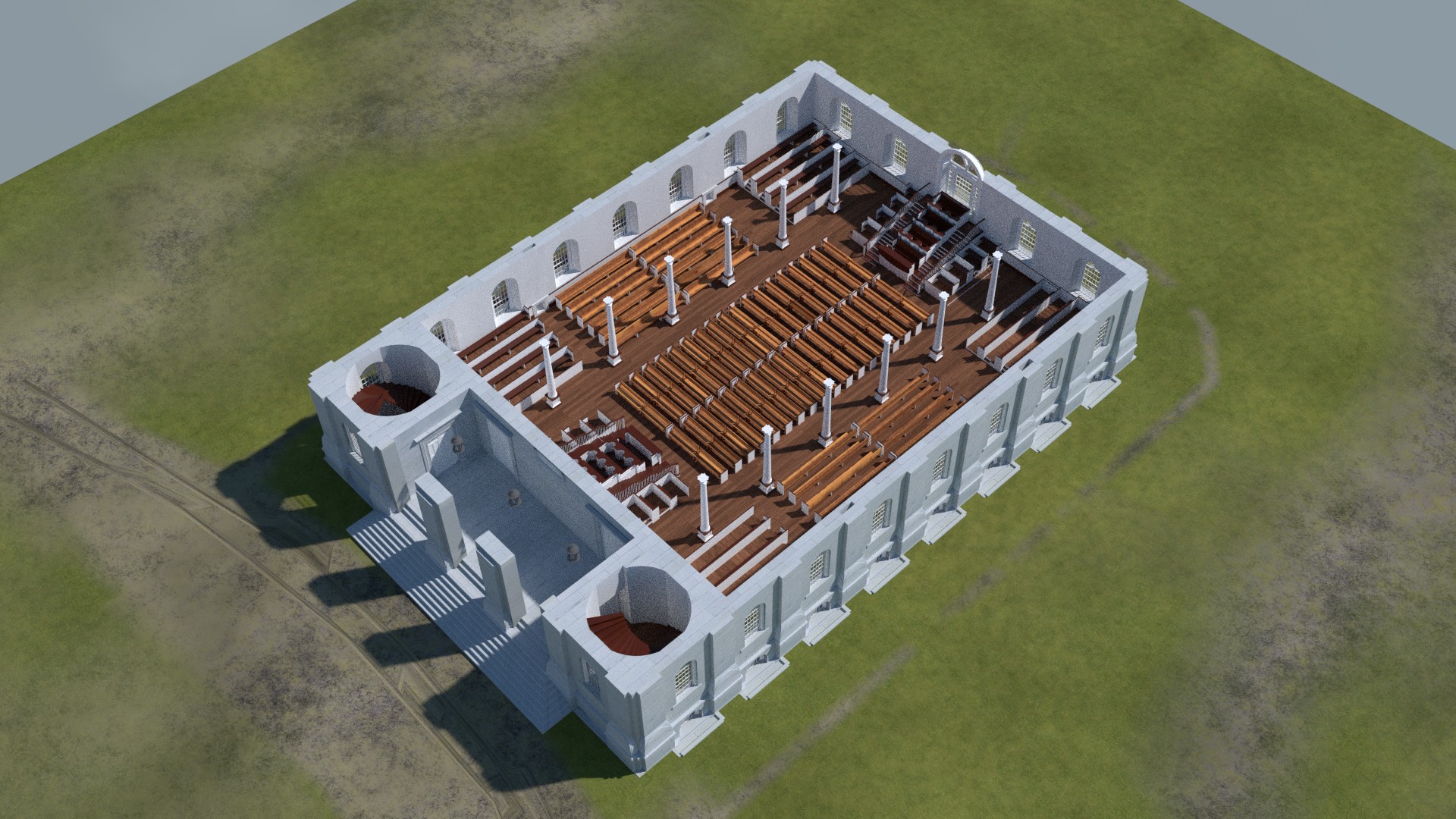
A flight of eight broad steps led to a landing where two more steps entered three archways. These archways led to the vestibule, the formal entrance to the temple. The archways were approximately nine feet wide and twenty-one feet high.
The vestibule itself was forty-three feet by seventeen feet in dimension. It was composed of limestone on all four of its walls. The floor has been speculated to be made of wood, because when the mob occupied the temple briefly in late 1847, they broke through the floor to reach a sealed off room in the basement. Had the floor been limestone, it seems unlikely that they would have dug it up.
Two large double doors on the east wall opened to the first floor assembly hall of the lower court, known as the “Great Hall”. Two doors, one on the North wall, and another on the South opened to the landing of two spiral staircases, one in the Northwest corner, and the other in the Southwest corner which led all the way to the attic. These were the only access points to the rest of the building.
One report stated that on the east wall of the vestibule was an entablature, similar to the one in the facade, which read in bright gilded letters, “THE HOUSE OF THE LORD – Built by The Church of Jesus Christ of Latter-Day Saints – Commenced April 6th, 1841 – HOLINESS TO THE LORD.”[10]Brown, Lisle G, “Nauvoo Temple Page,” Marshall.edu. accessed 17 October 2016.
The stairwells
The two stairwells were constructed of dressed limestone walls. One rose from Northwest corner and the other at the Southwest corner of the temple. They were not true circles but were flatted on four sides. Nor were they symmetrical, being sixteen feet in diameter from East to West and seventeen feet in diameter from North to South. This was done to support landings and other support structures.[11]Brown, Lisle G, “Nauvoo Temple Page,” Marshall.edu. accessed 17 October 2016.
The staircases, made of wood, provided access to all of the temple from the basement to the attic with a landing at each floor. They had lamps for illumination at night, and had windows for daytime illumination. William Weeks’ elevation of the front facade does not show windows at the basement level of the two stairwells, and photographic evidence is inconclusive. However, Joseph Smith’s youngest son, David Smith, rendered a painting of the temple’s damaged facade, clearly shows half-circular windows at the basement level in the north and south corners of the facade.[12]Brown, Lisle G, “Nauvoo Temple Page,” Marshall.edu. accessed 17 October 2016.
The staircase in the northwest corner was never completed. It was roughed in with temporary boards resting on the risers. Workmen used this staircase to gain access to the building during its construction, especially during the winter of 1845-1846 when persons were using the other staircase to reach the attic for ordinance work. The southwest staircase was completely finished for use. It included lamps for night illumination, and may have been carpeted near the attic landing.[13]Brown, Lisle G, “Nauvoo Temple Page,” Marshall.edu. accessed 17 October 2016.
Baptistry
Unlike Kirtland, the Nauvoo Temple had a full basement which housed a baptismal font. Because the Saints had to abandon Nauvoo, the building was not entirely completed. The basement with its font was finished, as were the first floor assembly hall and the attic. When these parts of the building were completed they were used for performing ordinances (basement and attic) or for worship services (first floor assembly hall).
The basement of the Nauvoo Temple was used as the baptistry, containing a large baptismal font in the center of the main room.
The basement was reached from the spiral staircases at the northwest and southwest corners of the temple. The staircase landing was made of wood and opened to a short hallway heading East, leading to the basement proper. Between the two hallways was an unfinished room sealed off from the rest of the temple, containing an old well that had been dug but never used. The room was discovered by an anti-Mormon mob who broke through the floor of the vestibule above.[14]Brown, Lisle G, “Nauvoo Temple Page,” Marshall.edu. accessed 17 October 2016.
The basement proper was one hundred feet long and forty feet wide with six rooms of varying sized on either side. The sides of the rooms were stone and abutted the massive stone piers that supported the floors above. With the exception of the two rooms at the West end of the basement, reportedly used for clerical purposes, each side room rose two steps in height from the basement floor. The rooms were dressing rooms for those using the font. The floor was made of red brick laid in a herringbone pattern. The walls were painted white. The floor sloped down to the center of the room to allow water to run toward a drain beneath the font.[15]Brown, Lisle G, “Nauvoo Temple Page,” Marshall.edu. accessed 17 October 2016.
BAPTISTRY
| Baptistries: | |
| Location: | |
| Exterior Windows: | |
| Artwork: | |
| Artwork Type: | |
| Oxen: | |
| Type: | |
| Hoof: | |
| Color: | |
| Layout: | |
| Font Exterior: | |
| Interior: | |
| Shape: | |
| Bowl Shape: | |
| Pillar: | |
| Stairs: | |
| Font Well: |
During an archaeological investigation of the temple site, two highly polished limestone blocks were discovered. Approximately twelve feet east of the entrance to the baptistry and ten feet from either the side of the support piers rested the blocks, roughly fourteen inches square, which projected seven inches (178 mm) above the brick floor. These objects are not mentioned in any account of the basement, and their purpose is unknown. They may have held some type of support columns, dividing the font from the entrance to the basement or they may have simply been a decorative element with a vase or something similar resting on them. They may have been part of a feature planned, but not used, in the final construction.[16]Brown, Lisle G, “Nauvoo Temple Page,” Marshall.edu. accessed 17 October 2016.
Every visitor who wrote about the temple mentioned the baptismal font. It was clearly the most impressive feature of the temple. There were actually two fonts built during the lifetime of the temple, a temporary wooden one, and a permanent limestone one.
The first font was built out of tongue and grooved white pine and painted white. It was sixteen feet long, twelve feet wide and four feet deep. The lip of the font was seven feet from the floor. The font’s cap and base were carved molding in an “antique style” and the sides were finished with panel work. Two railed stairways led to the font from the north and south sides.[17]Brown, Lisle G, “Nauvoo Temple Page,” Marshall.edu. accessed 17 October 2016. [18]The baptismal font is situated in the center of the basement room, under the main hall of the Temple; it is constructed of pine timber, and put together of staves tongued and grooved, oval shaped, sixteen feet long east and west, and twelve feet wide, seven feet high from the foundation, the basin four feet deep, the moulding of the cap and base are formed of beautiful carved work in antique style. The sides are finished with panel work. A flight of stairs in the north and south sides lead up and down into the basin, guarded by side railing. The font stands upon twelve oxen, four on each side, and two at each end, their heads, shoulders, and fore legs projecting out from under the font; they are carved out of pine plank, glued together, and copied after the most beautiful five-year-old steer that could be found in the country, and they are an excellent striking likeness of the original; the horns were formed after the most perfect horn that could be procured. The oxen and ornamental mouldings of the font were carved by Elder Elijah Fordham, from the city of New York, which occupied eight months of time. The font was enclosed by a temporary frame building sided up with split oak clapboards, with a roof of the same material, and was so low that the timbers of the first story were laid above it. The water was supplied from a well thirty feet deep in the east end of the basement. This font was built for the baptisms for the dead until the Temple shall be finished, when a more durable one will supply its place
The font was held up by twelve oxen as are almost all temple fonts. They were carved from pine planking that was glued together. They were patterned from the most beautiful five-year-old steer that could be found in the region. The head, shoulders and legs protruded beyond the base of the font, and they appeared to have sunk to their knees into the pavement. The most perfect horn that could be found was used to model the animals horns.[19]Brown, Lisle G, “Nauvoo Temple Page,” Marshall.edu. accessed 17 October 2016.
A decision was made to replace the wooden font in 1845, apparently because the water caused a mildew odor, and possibly because the wood began to rot. The new limestone font followed the pattern of the wooden one. Twelve oxen held up the basin, four on each side and two at each end. The oxen were solid stone and similarly were placed and appeared sunken into the floor. Where the oxen met the basin, the stone was carved to suggest drapery. The ears of the oxen were made of tin. The stairs were moved to an East/West orientation making access to the font easier.[20]Brown, Lisle G, “Nauvoo Temple Page,” Marshall.edu. accessed 17 October 2016.
A well on the east side of the font provided the water supply. There may have been some kind of tank at the East end of the baptistry to store and heat water.[21]Brown, Lisle G, “Nauvoo Temple Page,” Marshall.edu. accessed 17 October 2016.
Initiatory Spaces
text
INITIATORY
| Style | detached, attached, combined |
| Type | stationary, progressive |
| Rooms | # |
Instruction Rooms
text
INSTRUCTION ROOM
| Rooms | # |
| Type | # |
| Capacity | # |
| Murals | y/n |
| Total Muraled Rooms | # |
| Mural Type |
Celestial Room
text-images
Sealing Room
text-images
SEALING ROOM
| Sealing Rooms | |
| Largest Capacity |
Assembly Hall
Like Kirtland, the Nauvoo Temple contained two assembly halls, one on the first floor and one on the second, called the lower and upper courts.
ASSEMBLY HALL
| Assembly Halls | |
| Capacity |
Entrance to the first floor assembly hall, called the “Great Hall”, was through two large double doors at the east end of the vestibule. The Great Hall occupied the remainder of the floor space East of the vestibule. The room was flanked on either side by seven large, arched windows, with four similar windows along the east wall. An arched ceiling spanned some fifty feet in breadth, in the center. the floor was stained wood and the walls were painted white.[22]Brown, Lisle G, “Nauvoo Temple Page,” Marshall.edu. accessed 17 October 2016.
There were two rooms to the north just past the entrance. It has been suggested that these rooms were used initially by William Weeks, because they are referred by Thomas Bullock as the “architect’s room.” Their eventual intended use is not clear.[23]Brown, Lisle G, “Nauvoo Temple Page,” Marshall.edu. accessed 17 October 2016.
Pulpits
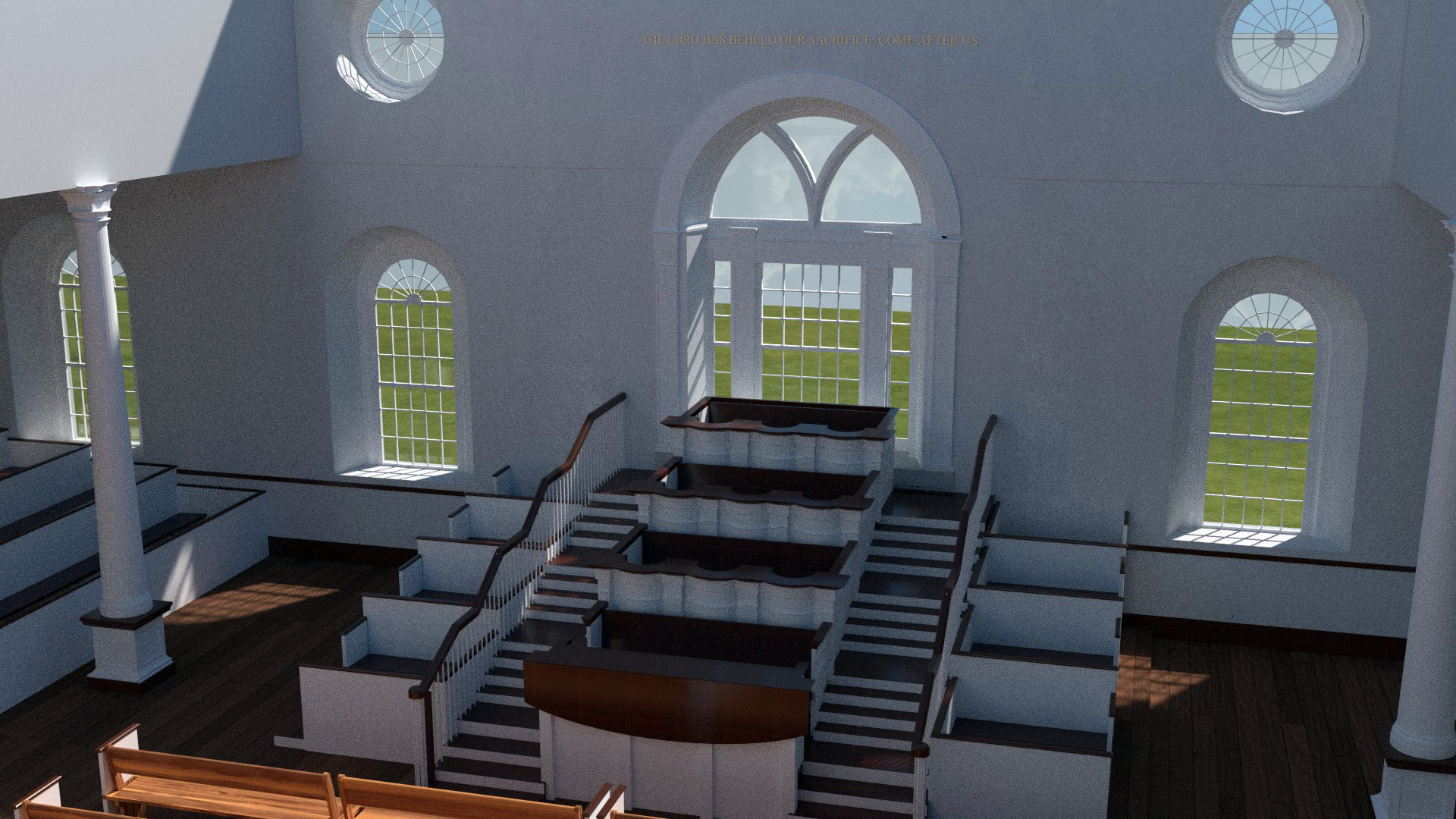
At the East and West ends of the hall were two sets of similar pulpits. Resembling the pulpits used in the Kirtland Temple, and repeated in later temples, they were arranged with four levels, the top three consisting of a group of three semi-circular stands. The lowest level was a drop-table which was raised for use in the sacrament.[24]Brown, Lisle G, “Nauvoo Temple Page,” Marshall.edu. accessed 17 October 2016.
The pulpits to the East, standing between the windows, were reserved for the Melchizedek Priesthood. Accordingly each pulpit had initials identifying the priesthood office of the occupant. The top most pulpits read P.H.P., which stood for President of the High Priesthood. The next level down had P.S.Q for President of the Seventy Quorums. Below that, the labels were P.H.Q. which stood for President of the High priests Quorum, and the folding table had the inscription P.E.Q. standing for President of the Elders Quorum.[25]Brown, Lisle G, “Nauvoo Temple Page,” Marshall.edu. accessed 17 October 2016.
Above the Eastern pulpits, written in gilded letters, along the arch of the ceiling, were the words,”The Lord Has Seen Our Sacrifice – Come After Us.”[26]Brown, Lisle G, “Nauvoo Temple Page,” Marshall.edu. accessed 17 October 2016.
The pulpits to the West end were reserved for the Aaronic Priesthood. Each pulpit similarly had initials identifying the priesthood officers who occupied that stand. The highest three pulpits bore the initials P.A.P., which stood for President of the Aaronic Priesthood. The next lower pulpits had P.P.Q., for President of the Priests Quorum). Again, the next had P.T.Q. for President of the Teachers Quorum and on the table at the bottom was written P.D.Q. for President of the Deacons Quorum.[27]Brown, Lisle G, “Nauvoo Temple Page,” Marshall.edu. accessed 17 October 2016.
Pews
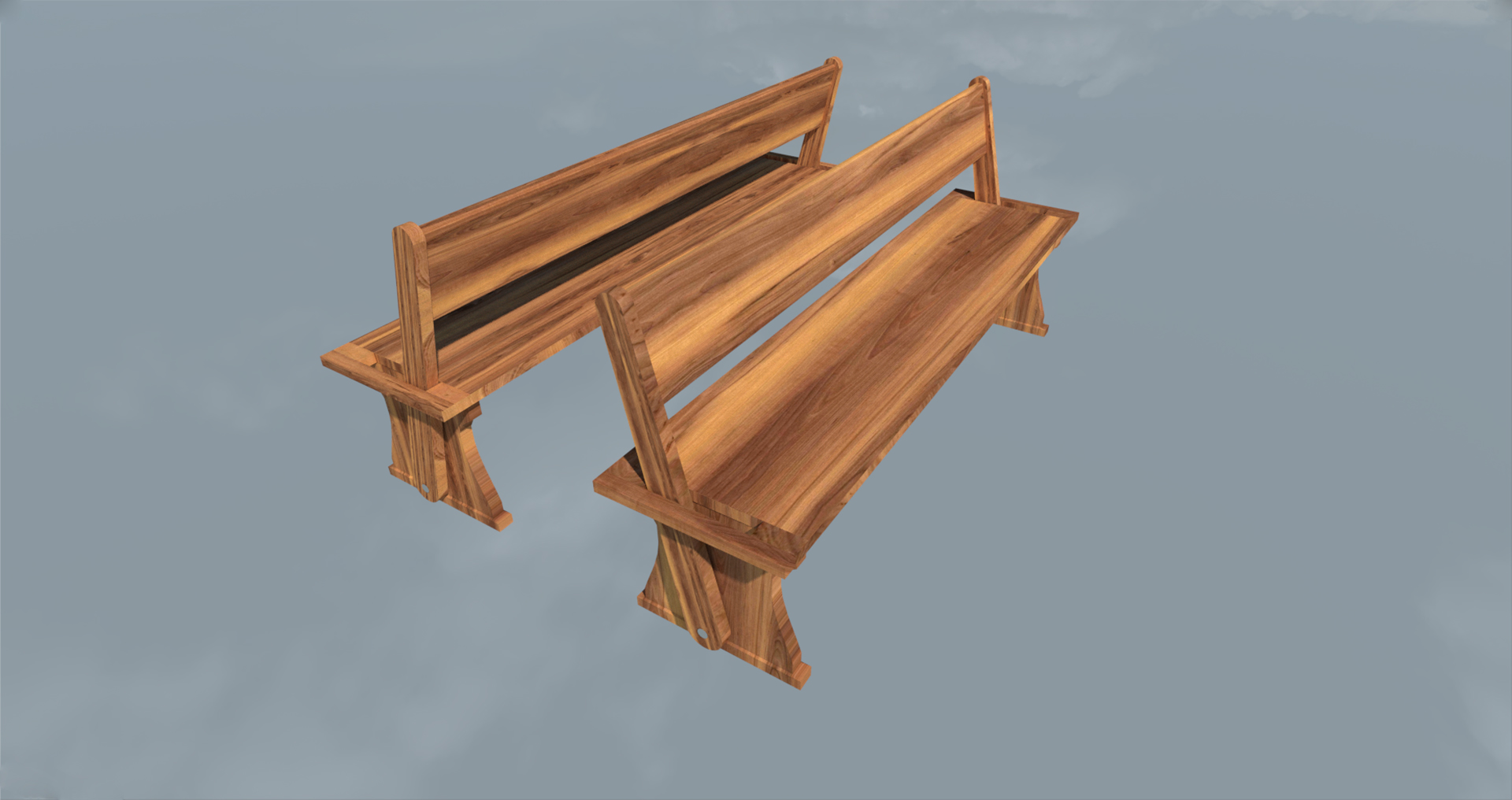
Unlike the Kirtland Temple,which had benches in enclosed “box” pews in the lower court, and “box” pews with benches facing each other in the upper court, in groups with two aisles running down its length, Nauvoo had single benches with a back that could be reversed to allow the members to face the pulpits at either end. There were also pews for a band and choir. The room could accommodate up to 3,500 people. Because there were pulpits on both ends of the room, the pews had movable backs which could be swung to face either direction, depending on who was presiding – the Melchizedek Priesthood or the Aaronic Priesthood.[28]Brown, Lisle G, “Nauvoo Temple Page,” Marshall.edu. accessed 17 October 2016.
First floor mezzanine
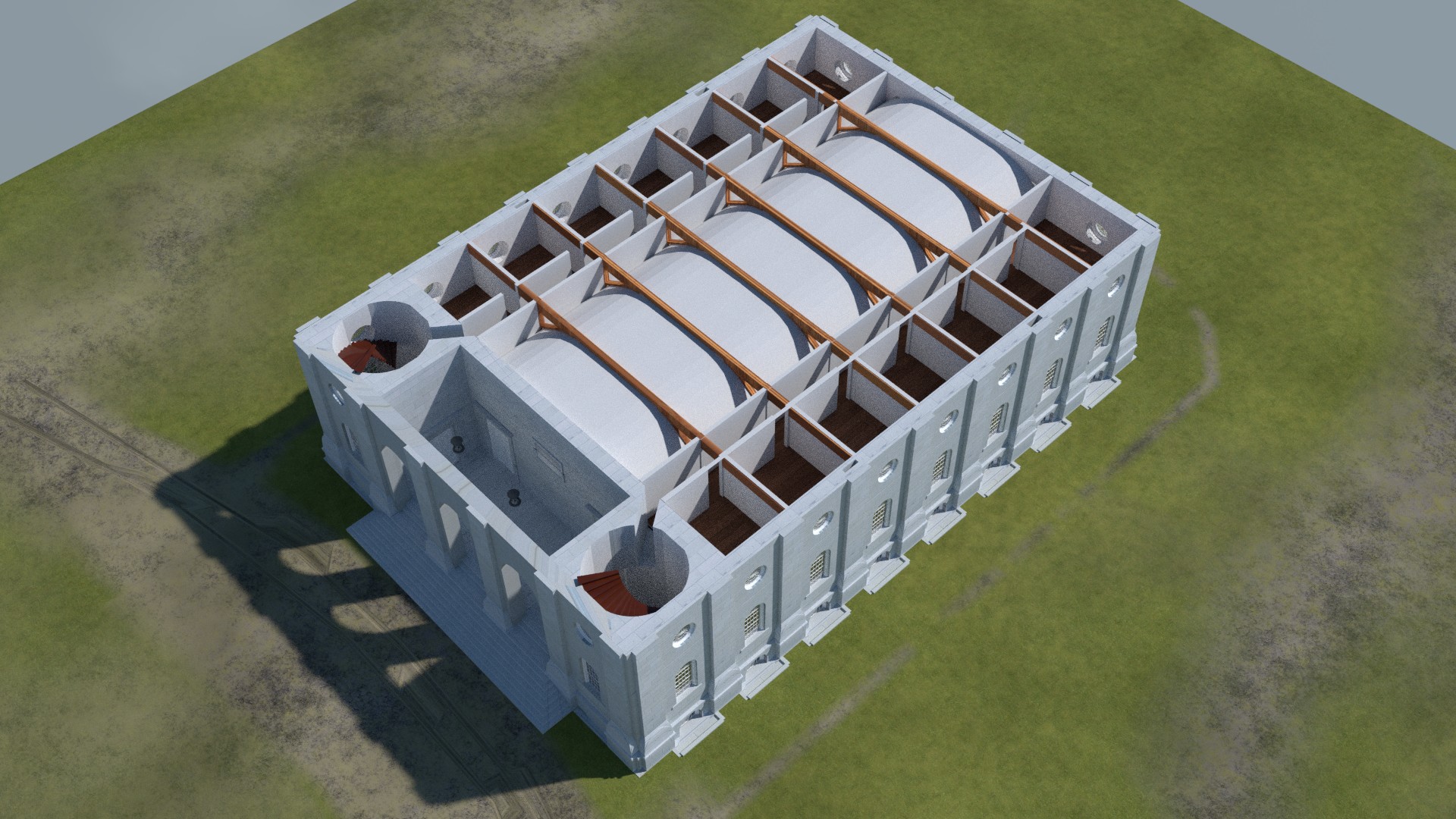
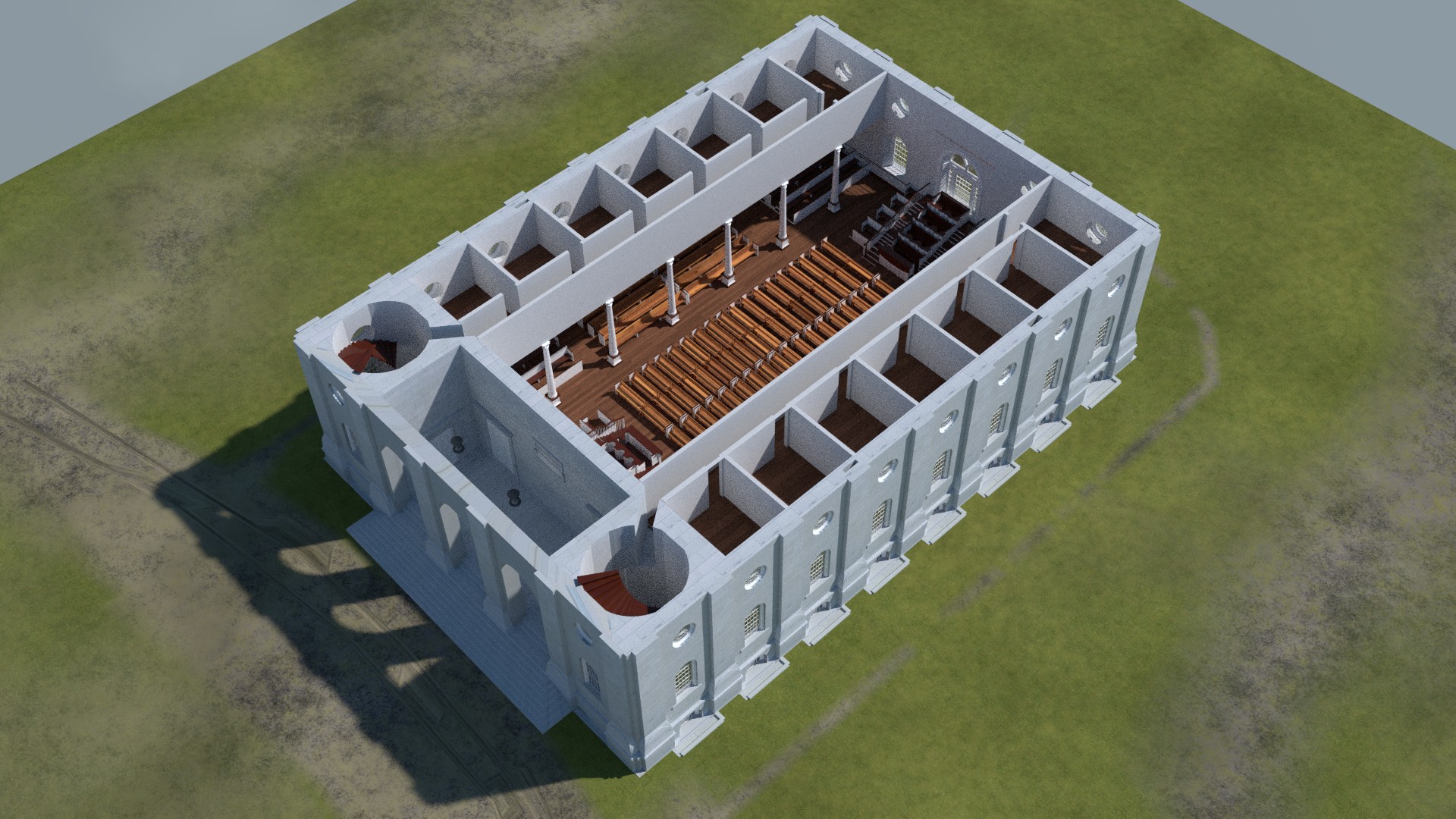
Access to the first floor mezzanine was directly from landings of the two staircases in the west end of the building. A foyer, corresponding in size to the vestibule below, connected the two stairway landings.
Evidence suggests that this mezzanine had fourteen small rooms, seven along each side of the North and South wall. Each room had a small circular window supplying light. These rooms may never have been completed, except perhaps some kind of partition dividing them.[29]Brown, Lisle G, “Nauvoo Temple Page,” Marshall.edu. accessed 17 October 2016.
Second floor assembly hall
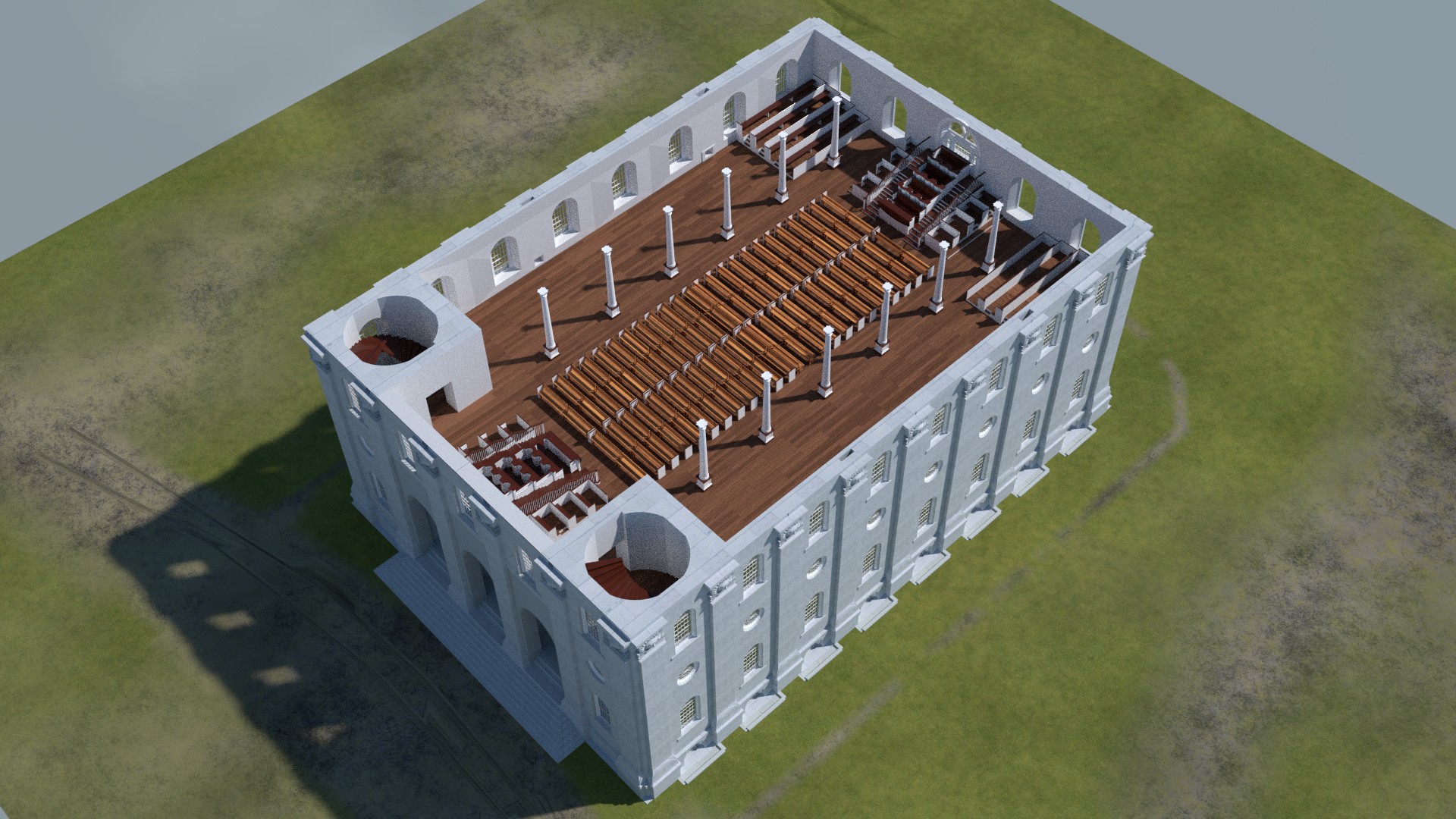
The second floor hall was similar in construction to the Great Hall, except that it included the foyer area where the vestibule would be. This made the room about seventeen feet longer. A 41-foot-long (12 m) stone arch ran north and south between the circular stairwells supporting the massive timbers for the tower above. It had seven large windows along the north and south wide, with four windows along the east wall.[30]Brown, Lisle G, “Nauvoo Temple Page,” Marshall.edu. accessed 17 October 2016.
The floor would have a similar configuration as the Great Hall with a set of double pulpits and pews, but the room was never completed. Doors were never hung, the plastering was unfinished, and the floorboards were only rough timber, not the tongue and grove finished hardwoods of the other floors. The room, when used for an occasional meeting, was furnished with wooden benches.[31]Brown, Lisle G, “Nauvoo Temple Page,” Marshall.edu. accessed 17 October 2016.
Second floor mezzanine rooms
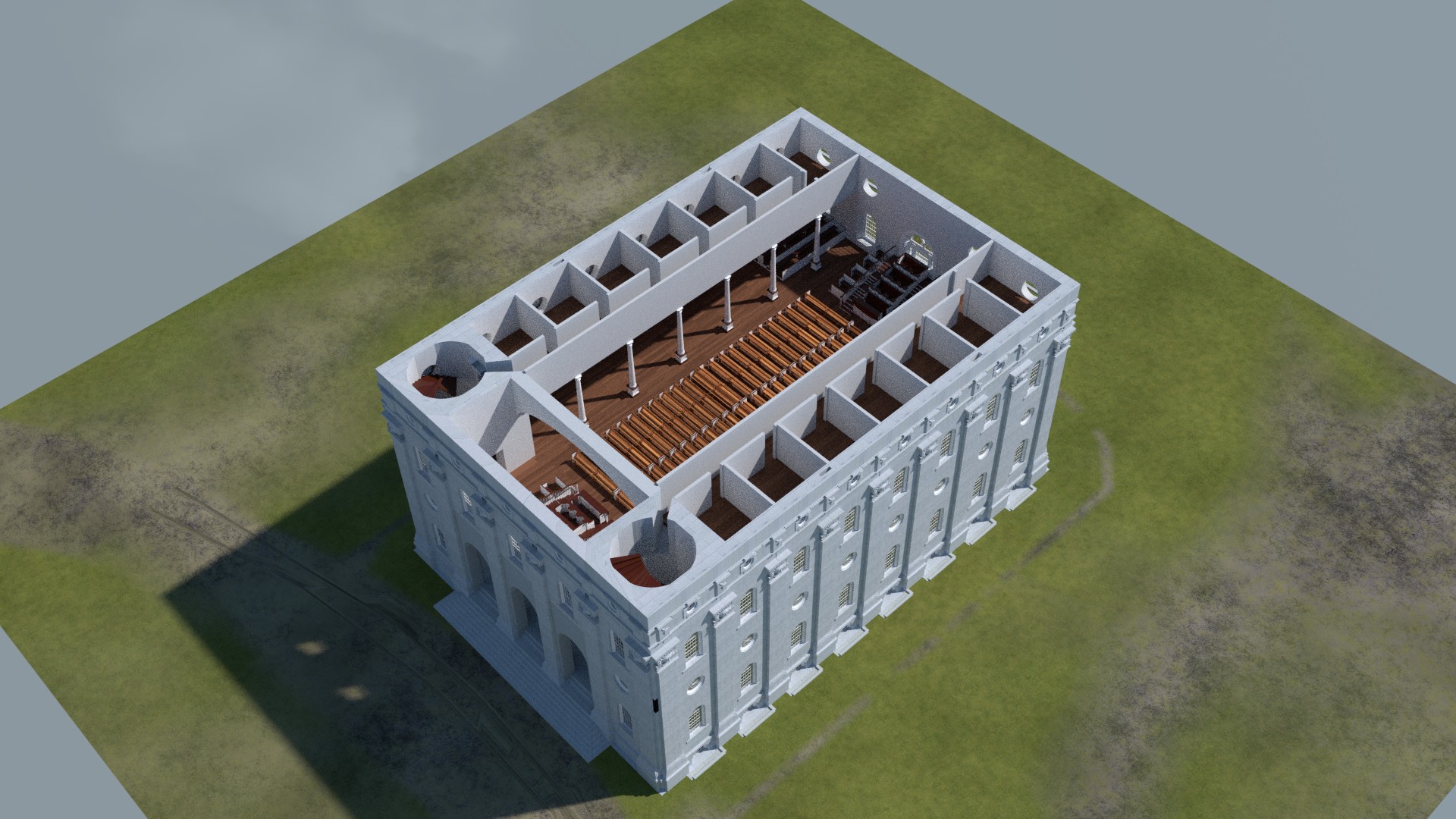
The second mezzanine was similar to the first floor mezzanine. It was accessed via the two staircases at the West end of the building. There was no foyer connecting the two stairwells.[7]
The second floor mezzanine is also presumed to have been divided into fourteen small rooms, seven rooms along each side of the North and South walls of the building, between the arched ceiling of the second floor. Circular windows in the entablature of the building allowed for illumination. Just as with the second floor assembly room, there is no evidence that these rooms were ever completed, except perhaps for the partitions dividing each room. There was a staircase in the second room from the Southeast corner leading to a room above, providing another access method to the attic.[32]Brown, Lisle G, “Nauvoo Temple Page,” Marshall.edu. accessed 17 October 2016.
Attic
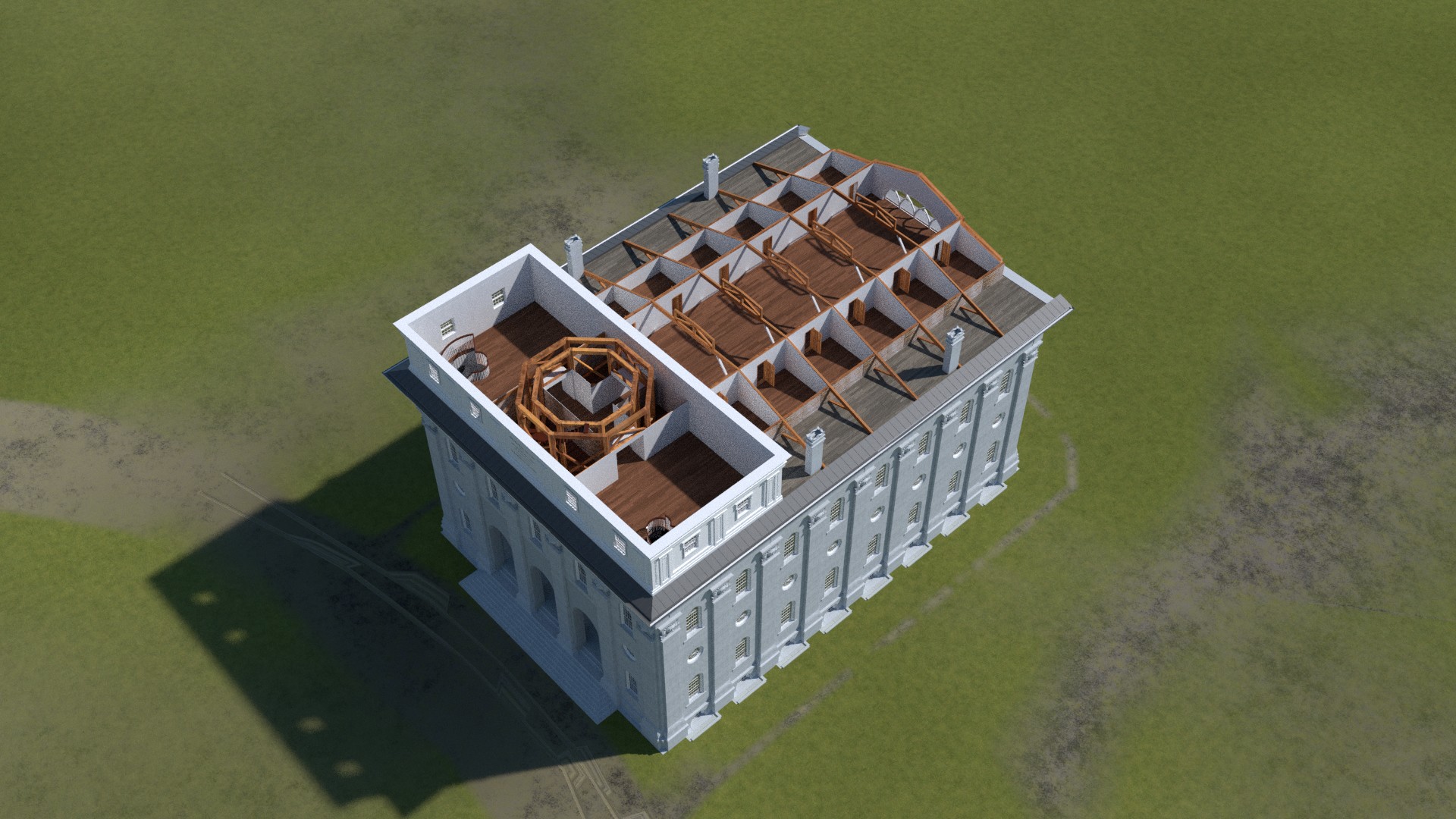
At the top of the two stairways, opening to a foyer, was the attic floor. The attic was not built of limestone but of wood. It was composed of two sections. The West end of the temple was a flat roofed section that supported the tower. The rest of the attic was a pitched-roof section running the length of the temple.[backref name=”marshall”]
The flat-room section was further divided into two sections, the foyer on the west side, and a suite of rooms to the east. When the attic was used for ordinance work, they were used as a pantry, wardrobe and storage rooms. The area was illuminated by six windows along the foyer’s west wall. Outside windows also provided light along the north and south sides. The roof had four octagonal skylight windows to provide light to the interior rooms, in addition to a twenty-foot arched window.[33]Brown, Lisle G, “Nauvoo Temple Page,” Marshall.edu. accessed 17 October 2016.
The incline of the roof prevented a six-foot-tall man from standing erect along the outside wall. The second room from the south-east corner had a stairway leading to a room in the mezzanine below.[34]Brown, Lisle G, “Nauvoo Temple Page,” Marshall.edu. accessed 17 October 2016.
Tower rooms
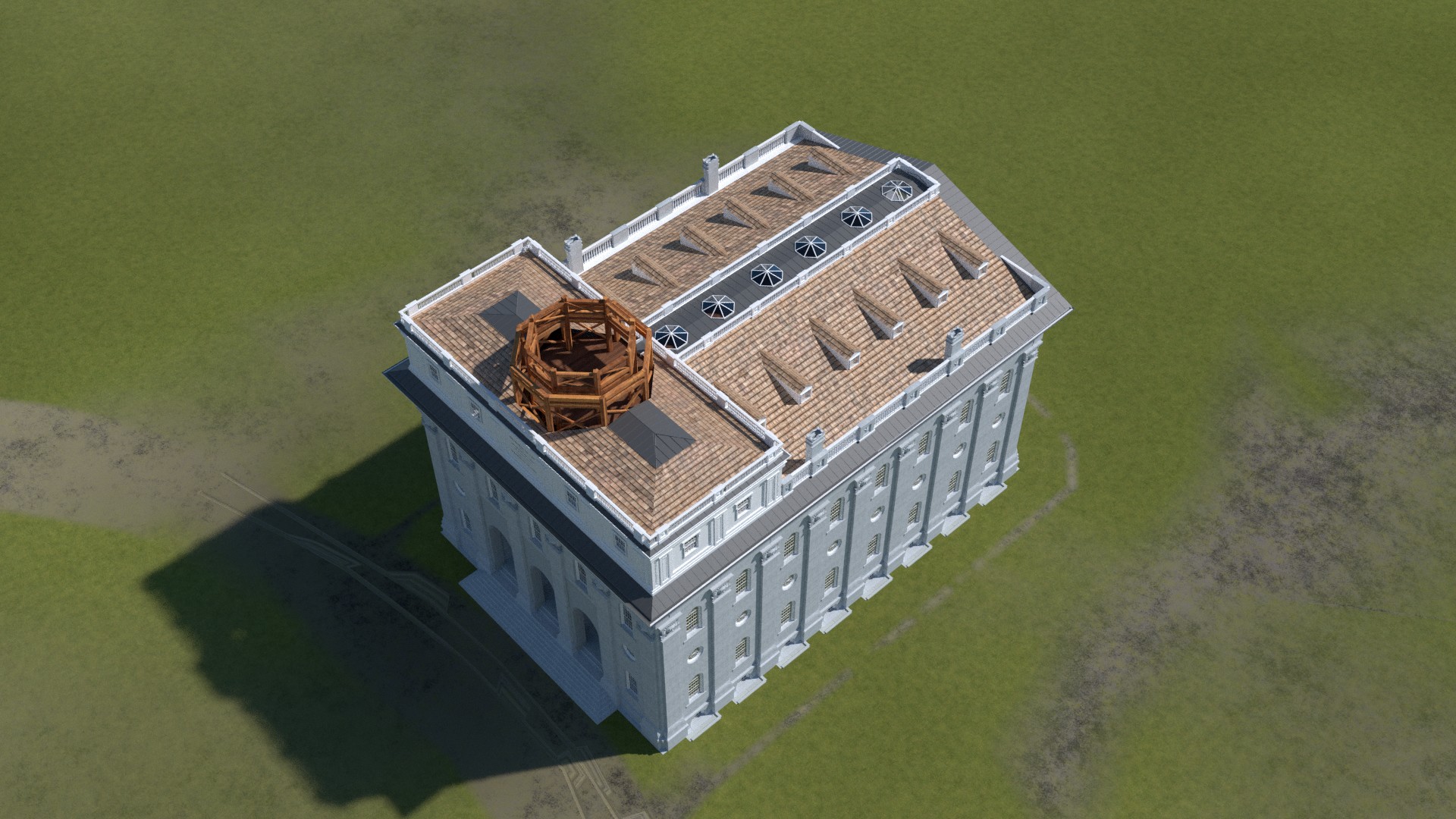
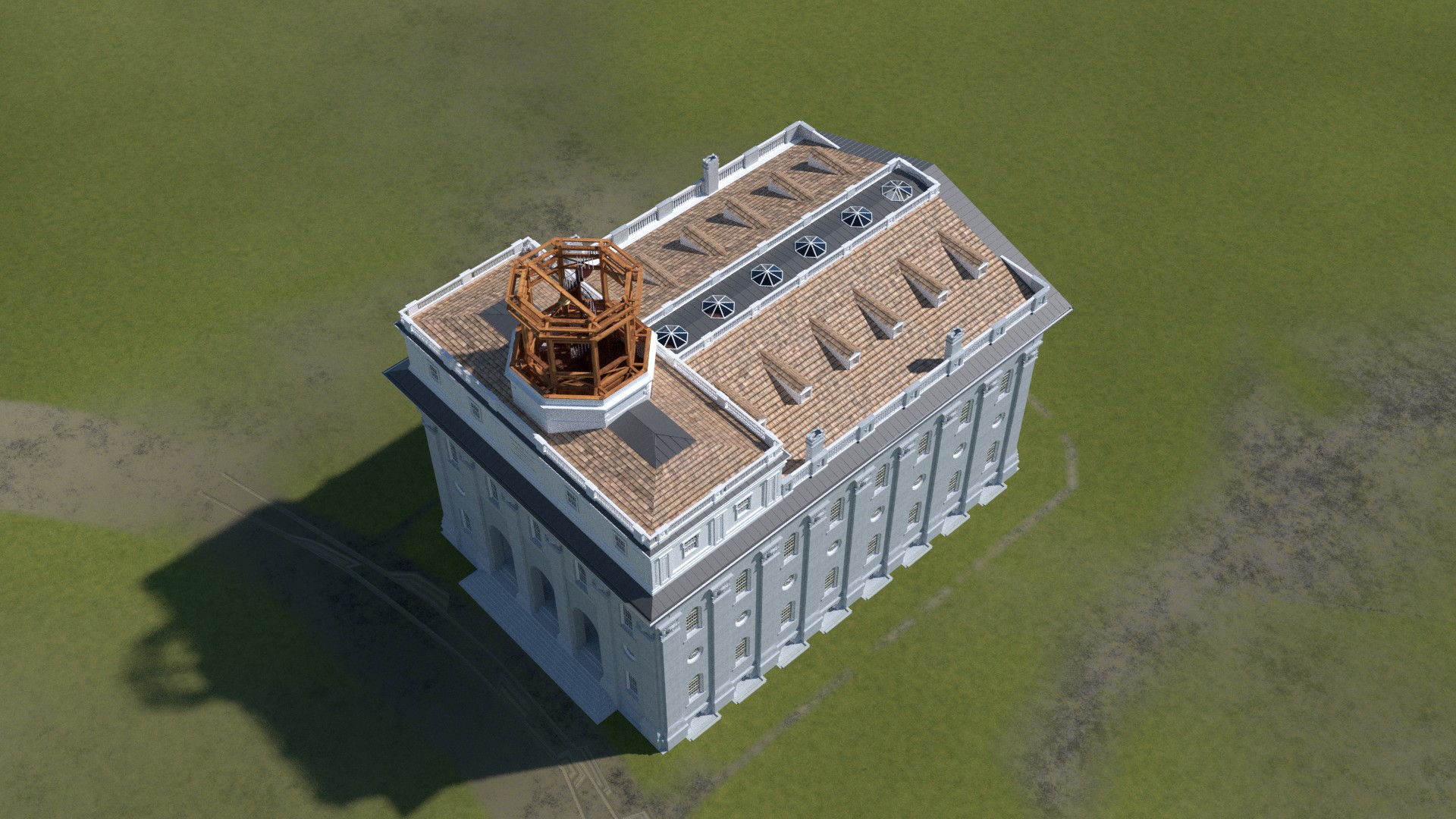
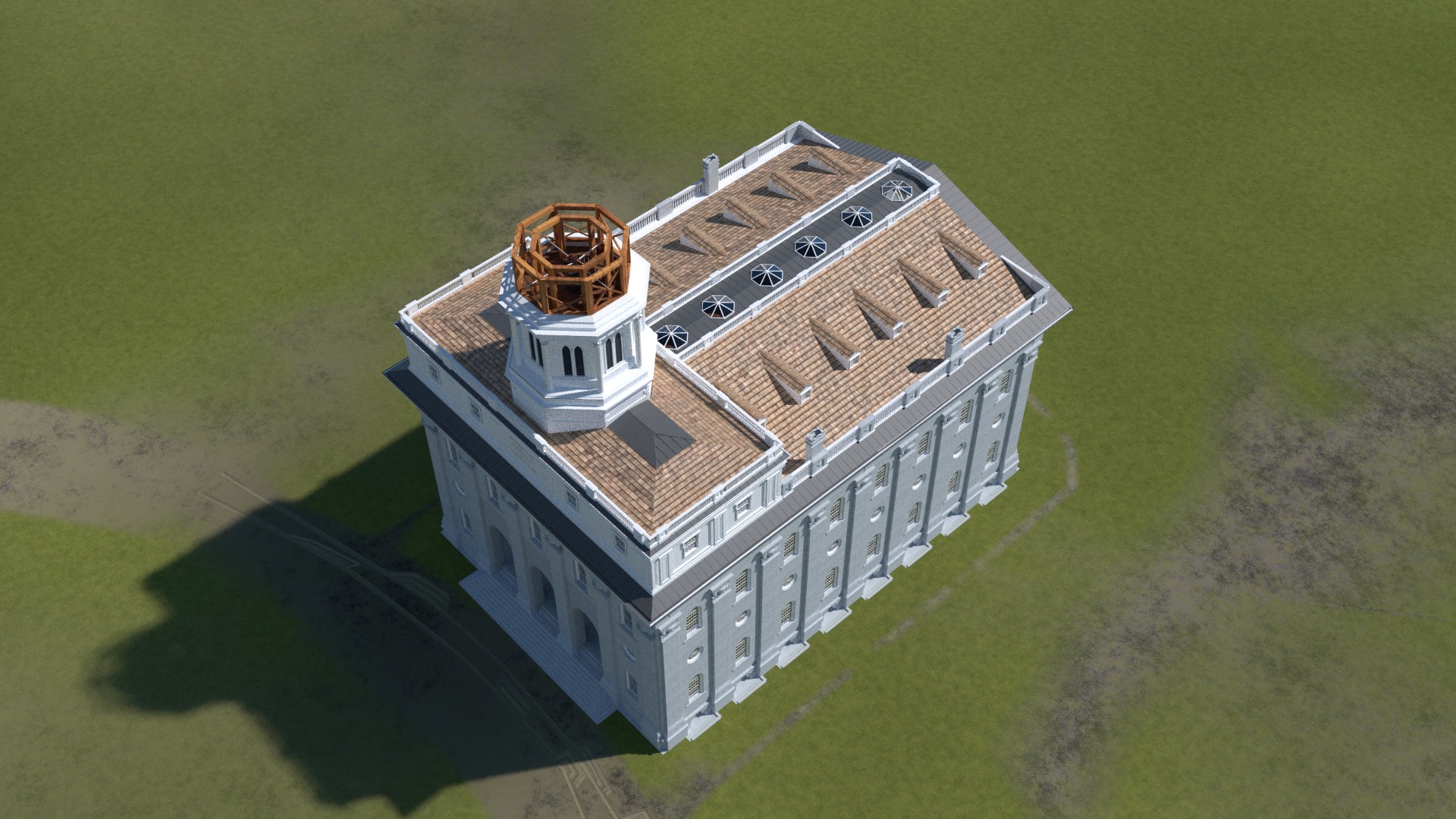
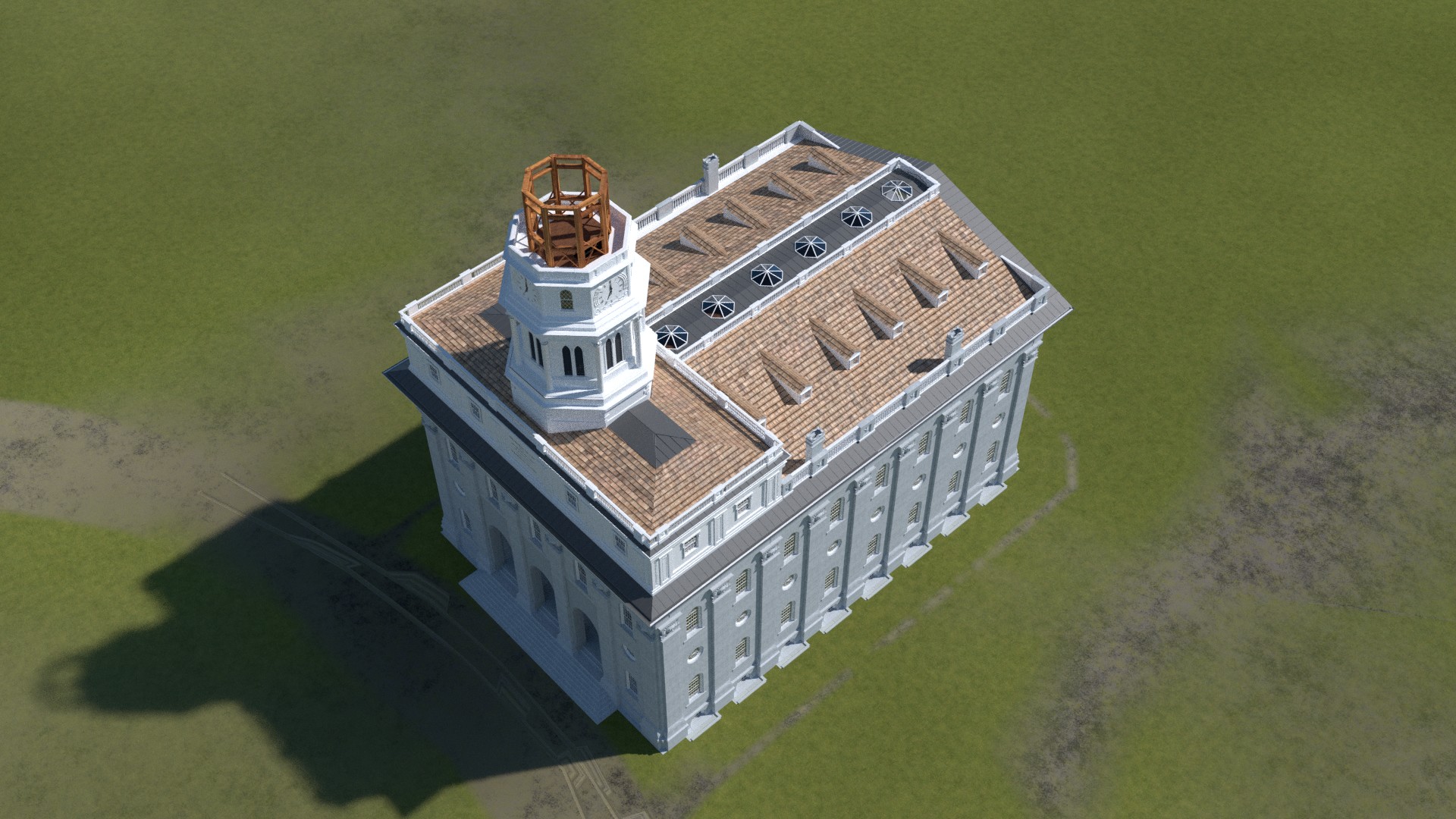
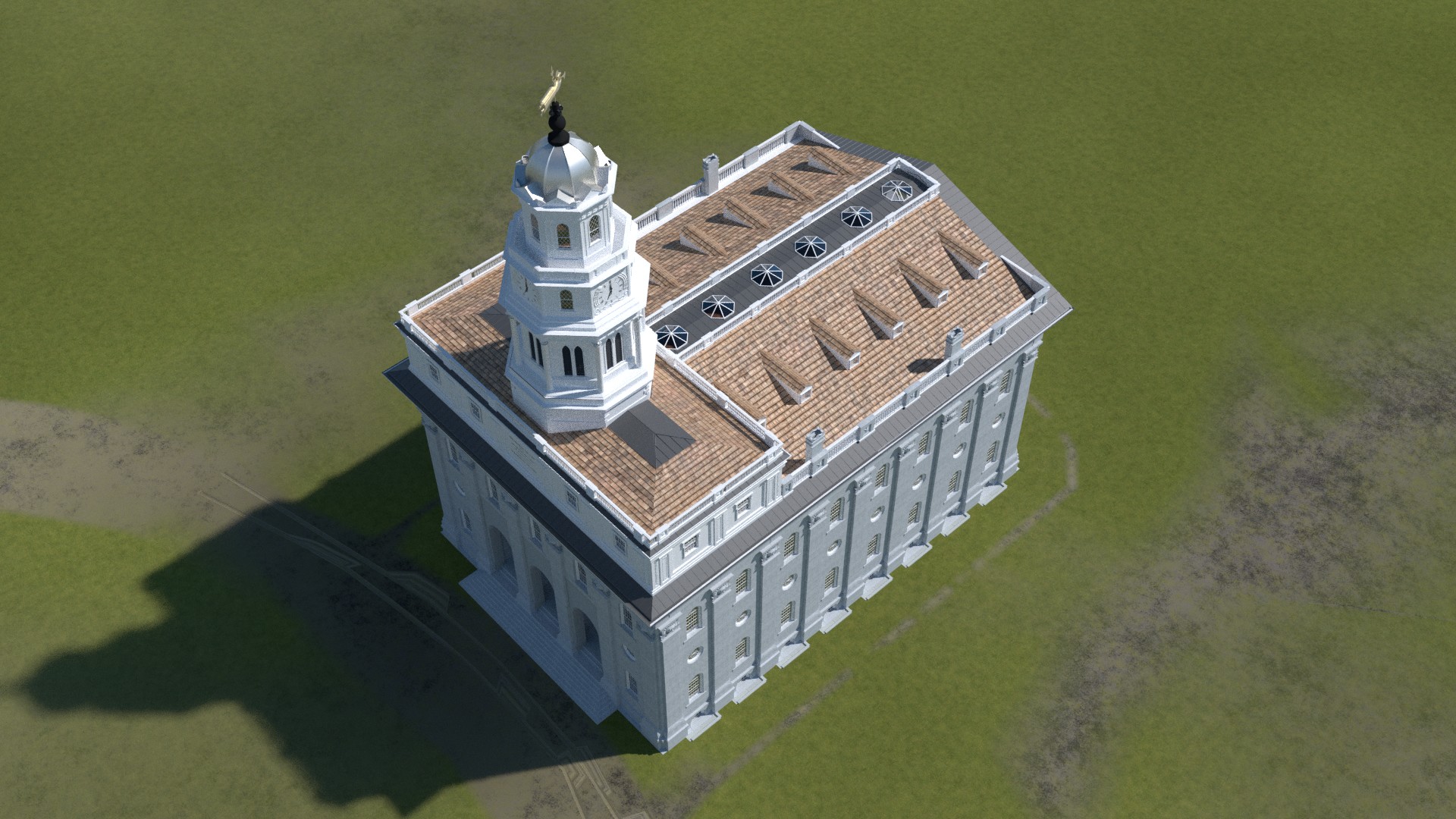
Rising from the plateau of the attic is an octagonal tower. The tower was divided into three sections, each accessible by a series of stairways leading from the attic to an observation deck at the top. The lowest section was the belfry. The bell was rung for various occasions. Between the observation deck and the belfry was a section containing the four clockwork mechanisms.[backref name=”marshall”]
Weather vane
The Nauvoo temple was the first to have a gilded angel at its peak. However, this angel, rather than being explicitly named as Moroni, was a representation of the angel described in the verse in Revelation 14:6:
“And I saw another angel fly in the midst of heaven, having the everlasting gospel to preach unto them that dwell on the earth, and to every nation, and kindred, and tongue, and people.”
It was, a 3-dimensional weather vane in the form of an unnamed figure made of tin and gilded in gold. It was fashioned in the likeness of a man, holding a book raised in one hand and a trumpet to his lips in the other, wearing robes and a cap and laying horizontal as if flying.
Sources and Citations
Additional Reading
- Brown, Lisle G. (2002). “”A Perfect Estopel”: Selling the Nauvoo Temple”. Mormon Historical Studies 3 (2): 61–85.
- Brown, Lisle G. (1979). “The Sacred Departments for Temple Work in Nauvoo: The Assembly Room and the Council Chamber”. BYU Studies 19 (3): 361–374.
- Brown, Lisle G. (2002). “Nauvoo’s Temple Square”. BYU Studies 41 (4): 1–45.
- Brown, Lisle G. (February 2000). “Chronology of the Construction, Destruction, and Reconstruction of the Nauvoo Temple”. Retrieved June 3, 2013.
- Colvin, Don (2002). The Nauvoo Temple: A Story of Faith. American Fork, Utah: Covenant Communications.
- Crocket, David R. (1999). “The Nauvoo Temple, A Monument of the Saints” (PDF). Nauvoo Journal 11 (1): 5–30.
- McBride, Mathew S. (2007). A House for the Most High: The Story of the Original Nauvoo Temple. Salt Lake City, Utah: Greg Kofford Books. ISBN 1-58958-016-8.
- Nauvoo: History in the Making. (2002) CD-ROM. Salt Lake City: Deseret Book.
- Horner, Henry (1939), Illinois, A Descriptive and Historical Guide, Chicago: Federal Writer’s Project of the Work Projects Administration for the State of Illinois, p. 352
- Harrington, Virginia S.; Harrington, J.C. (1971), Rediscovery of the Nauvoo Temple: Report on the Archaeological Excavations, Salt Lake City: Nauvoo Restoration, p. 5, OCLC 247391
- H. Michael Marquardt and Wesley P. Walters (1994). Inventing Mormonism: Tradition and the Historical Record (Salt Lake City, Utah: Signature Books) p. 160.
- Manuscript History of the Church, LDS Church Archives, book A-1, p. 37; reproduced in Dean C. Jessee (comp.) (1989). The Papers of Joseph Smith: Autobiographical and Historical Writings (Salt Lake City, Utah: Deseret Book) 1:302–03.
References
| ↑1 | Manuscript History of the Church, LDS Church Archives, book A-1, p. 37; reproduced in Dean C. Jessee (comp.) (1989). The Papers of Joseph Smith: Autobiographical and Historical Writings (Salt Lake City, Utah: Deseret Book) 1:302–03. |
|---|---|
| ↑2 | Documentary History of the Church, IV, p. 186-187 |
| ↑3 | ”Section 124,” Doctrine and Covenants, p.246, https://www.churchofjesuschrist.org/study/scriptures/dc-testament/dc/124 |
| ↑4 | Roberts, History of the Church, 7:580. |
| ↑5 | (Essentials in Church History by Joseph Fielding Smith, pp. 310-1.) |
| ↑6 | Garner, Dean E. “Nauvoo’s Temple” BYUI.edu. accessed 5 June 2015. |
| ↑7 | Horner, Henry (1939), Illinois, A Descriptive and Historical Guide, Chicago: Federal Writer’s Project of the Work Projects Administration for the State of Illinois, p. 352 |
| ↑8 | Harrington, Virginia S.; Harrington, J.C., “Rediscovery of the Nauvoo Temple: Report on the Archaeological Excavations,” Salt Lake City: Nauvoo Restoration, p. 5, year 1971. OCLC 247391 |
| ↑9 | Wandle Mace, Autobiography 207 (BYU Special Collections) |
| ↑10, ↑11, ↑12, ↑13, ↑14, ↑15, ↑16, ↑17, ↑19, ↑20, ↑21, ↑22, ↑23, ↑24, ↑25, ↑26, ↑27, ↑28, ↑29, ↑30, ↑31, ↑32, ↑33, ↑34 | Brown, Lisle G, “Nauvoo Temple Page,” Marshall.edu. accessed 17 October 2016. |
| ↑18 | The baptismal font is situated in the center of the basement room, under the main hall of the Temple; it is constructed of pine timber, and put together of staves tongued and grooved, oval shaped, sixteen feet long east and west, and twelve feet wide, seven feet high from the foundation, the basin four feet deep, the moulding of the cap and base are formed of beautiful carved work in antique style. The sides are finished with panel work. A flight of stairs in the north and south sides lead up and down into the basin, guarded by side railing. The font stands upon twelve oxen, four on each side, and two at each end, their heads, shoulders, and fore legs projecting out from under the font; they are carved out of pine plank, glued together, and copied after the most beautiful five-year-old steer that could be found in the country, and they are an excellent striking likeness of the original; the horns were formed after the most perfect horn that could be procured. The oxen and ornamental mouldings of the font were carved by Elder Elijah Fordham, from the city of New York, which occupied eight months of time. The font was enclosed by a temporary frame building sided up with split oak clapboards, with a roof of the same material, and was so low that the timbers of the first story were laid above it. The water was supplied from a well thirty feet deep in the east end of the basement. This font was built for the baptisms for the dead until the Temple shall be finished, when a more durable one will supply its place |
Last updated on: 24 April 2026